Japanese Maple vs Red Maple Tree: Which to Choose?

When you’re choosing a maple tree, Japanese maple and red maple can both be appealing for their foliage and fall color. But their size difference means they play different roles in your landscape. Japanese maple is a smaller ornamental tree, while red maple is a much larger, faster-growing shade tree.
A quick guide to choosing your best fit
Fall color isn't what separates these two, since both put on a real show. The Japanese maple vs red maple decision comes down to how much open ground you have and whether you want an accent or actual shade. Speed is the tiebreaker.
- Choose a Japanese maple if your planting spot is narrower than about 25 feet and you want an ornamental tree with distinctive leaves, colorful foliage, and a range of compact shapes.
- Choose a red maple if you have 30 feet or more of open space and want a tree you can sit under, with a 40- to 50-foot canopy throwing real shade within 15 to 20 years.
Is a Japanese maple a red maple?
Yes, they are relatives in the same genus.
Red maple is the common name for Acer rubrum, a large North American shade tree whose native range NC State Extension traces from Newfoundland to Florida and west to Texas. Japanese maple is Acer palmatum, which NC State Extension lists as native to central and southern Japan and southeast Korea.
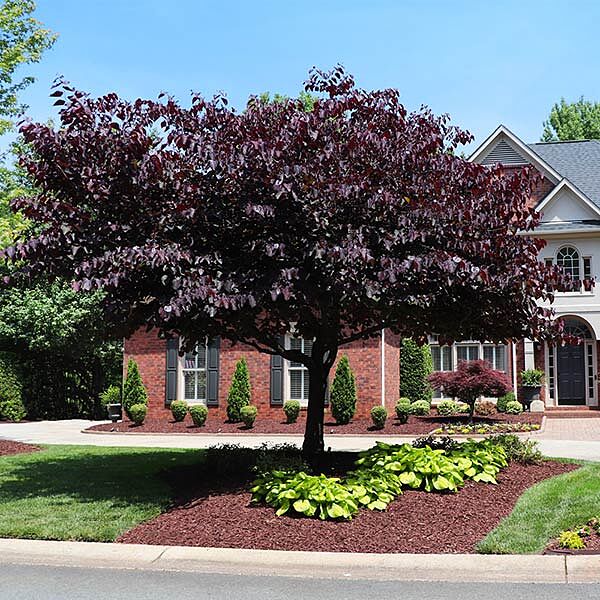
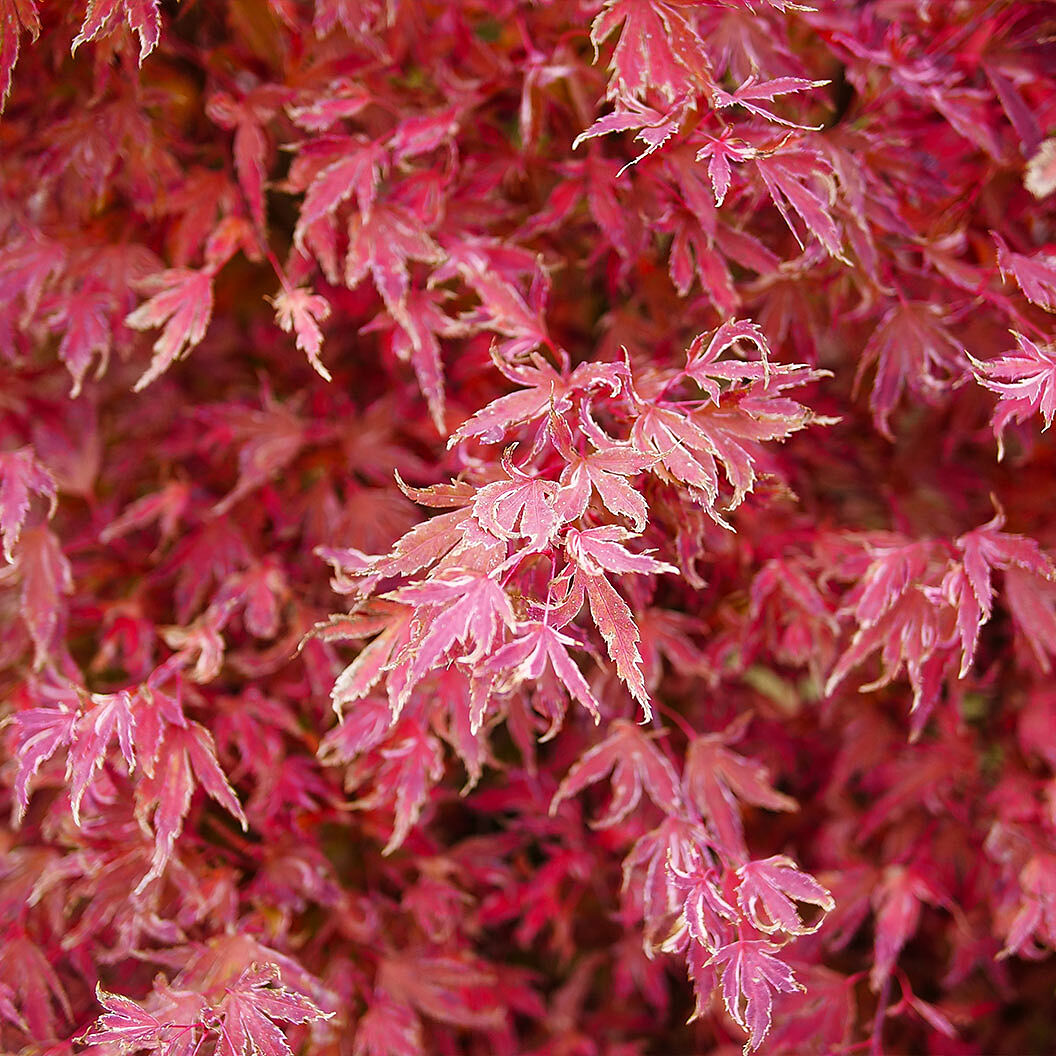
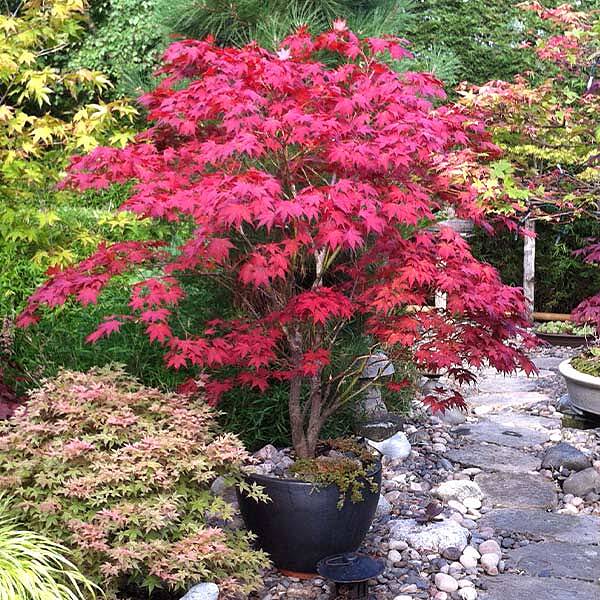
Still, if you have ever heard of the name “Japanese red maple,” you may be confused. But this is a common nickname for some Japanese maples with red or purple foliage, not the botanical name of a separate type of red maple. Plenty of Acer palmatum cultivars, including Bloodgood and Red Dragon, hold red or purple foliage all summer instead of waiting for October, so they’re sometimes called red maples even though they are not the same species as Acer rubrum.
Japanese maple vs red maple at a glance
Here's how the two compare side by side.
|
Japanese Maple |
Red Maple |
|
|---|---|---|
|
Botanical name |
Acer palmatum |
Acer rubrum |
|
Native origin |
Central and southern Japan, southeast Korea |
Eastern and central North America |
|
Mature height (species) |
15���25 ft.; laceleaf forms 6–12 ft. |
40–70 ft., occasionally far taller |
|
Mature width (species) |
15–35 ft. |
30–50 ft. |
|
Growth rate |
Slow to moderate |
Rapid |
|
Growing zones |
5–8 |
2–9 |
|
Trunk form |
Often multi-stemmed; upright, weeping, or mounding |
Single central trunk, upright oval crown |
|
Root system |
Proportionally small and fine |
Shallow, with a dense mat of surface roots |
|
Soil |
Well drained, consistently moist but not wet. Prefers soils high in organic matter with an acidic pH. Prone to chlorosis in alkaline soils |
Medium to wet, well drained. Acidic soil pH. Prone to chlorosis in alkaline soils. Can tolerate brief drought or flooding |
|
Leaf |
2–5 in., five to nine deeply cut lobes |
2–6 in., three to five toothed lobes that look hand-like; dissectum group has lace-like leaves |
|
Summer foliage |
Green, red, or purple by cultivar |
Medium to dark green |
|
Fall color |
Yellow, bronze, purple, red |
Red, orange, and yellow, early |
|
Sunlight |
Dappled to partial shade; afternoon protection in hot summers |
Full sun to partial shade |
|
Best use |
Ornamental accent, patio, foundation bed, container |
Shade tree for an open lawn |
|
At Trees.com |
Cultivars 6–25 ft., zones 5–8 |
Cultivars 40–50 ft., zones 3–9 |
What the table is telling you:
- Height is the whole story. At the top of its range a red maple is roughly three times the tree a Japanese maple will ever be. Japanese maples are grown as small shade trees or accent trees, and are well suited for containers.
- Red maple has the best cold hardiness. Some red maple varieties are cold hardy to zone 2, while Japanese maples are generally cold hardy to zone 5.
- Red maples can handle wetter soils. Japanese maples need consistently moist but well-draining soil, as overly wet or poorly drained conditions can lead to root rot.

Key differences between Japanese maple and red maple
Once you know how large each tree can become, four differences will help you decide where each one belongs: mature size and growth rate, color, shape, and root growth.
Mature size and growth rate
Red maple is the larger and faster-growing tree. NC State Extension puts the species at 40 to 70 feet tall with a 30- to 50-foot spread and rates its growth as rapid.
Japanese maple grows much more slowly and stays considerably smaller. The Morton Arboretum lists Acer palmatum at 15 to 25 feet tall and 15 to 35 feet wide with slow growth, and NC State Extension puts the dissected laceleaf group at just 6 to 12 feet. It takes patience, but that's part of the appeal: you're growing a small ornamental tree, not waiting for it to become a shade tree.
Leaves and fall color
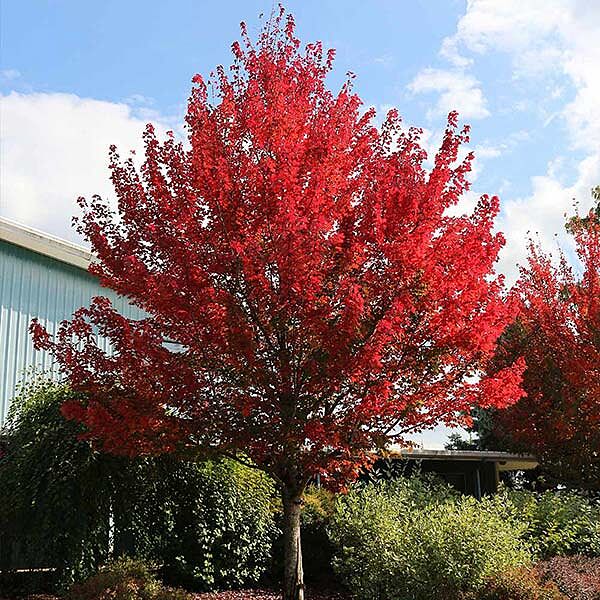
Hold a leaf from each tree side by side from each of these fall maples and you'll never mix them up again. Red maple leaves are typically 2 to 6 inches long with three to five triangular lobes and coarsely toothed margins. They stay green through summer before turning brilliant red, orange, and yellow early in fall.
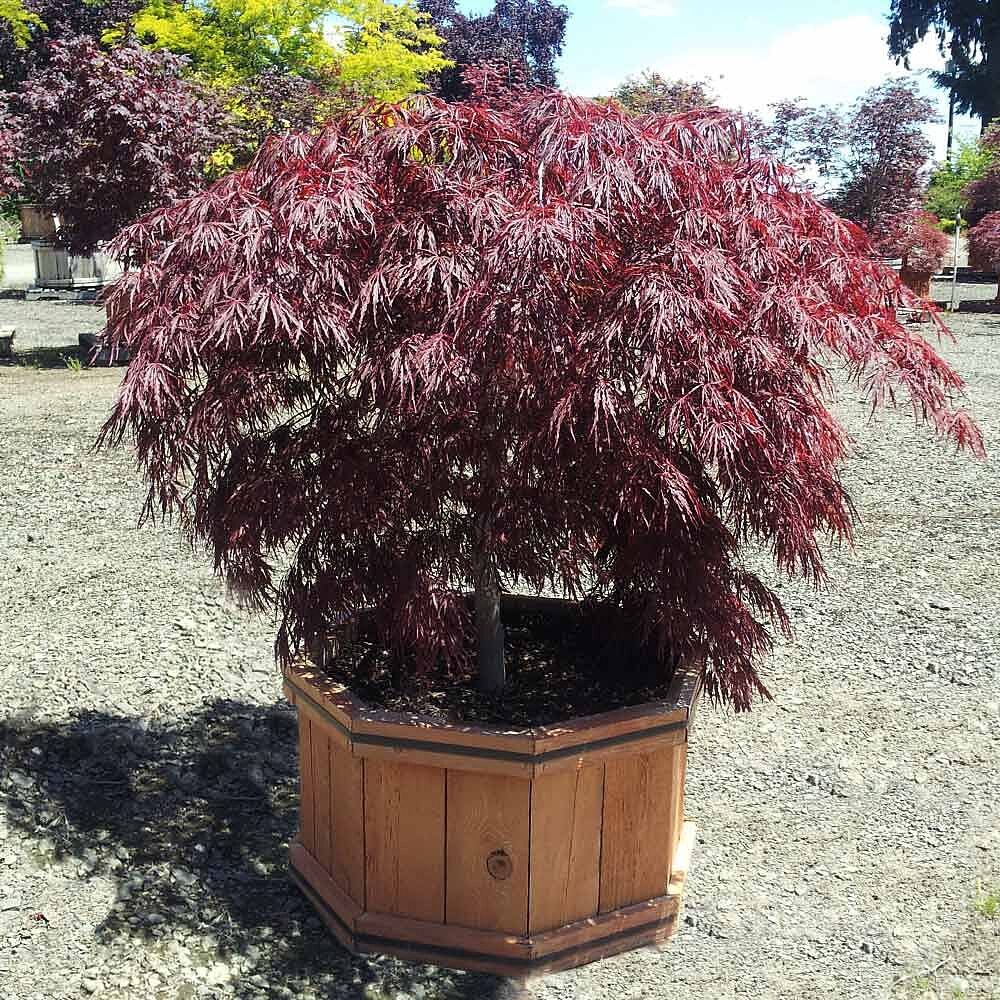
Japanese maple leaves run 2 to 5 inches with five to nine lobes, most cut deeply toward the base. Palmatum means shaped like a hand, and one look at those fingered, lobed leaves tells you why. The dissectum group, also called laceleaf or cut-leaf maples, have 5-7 deeply cut lobes that give them a lacey or feathery quality.
Shape and root growth
Red maple grows an upright, oval crown on a single central trunk, but its roots can spread well beyond the canopy. Its shallow surface roots can become problematic near sidewalks, driveways, and septic systems, so give the tree plenty of space when choosing a planting location. NC State Extension notes it forms a dense mat of surface roots that outcompetes whatever is growing in its shade, and University of Maryland Extension lists maples among the species most prone to surface rooting. Give it room and it's a wonderful tree. Crowd it and you'll be dealing with those roots for thirty years.
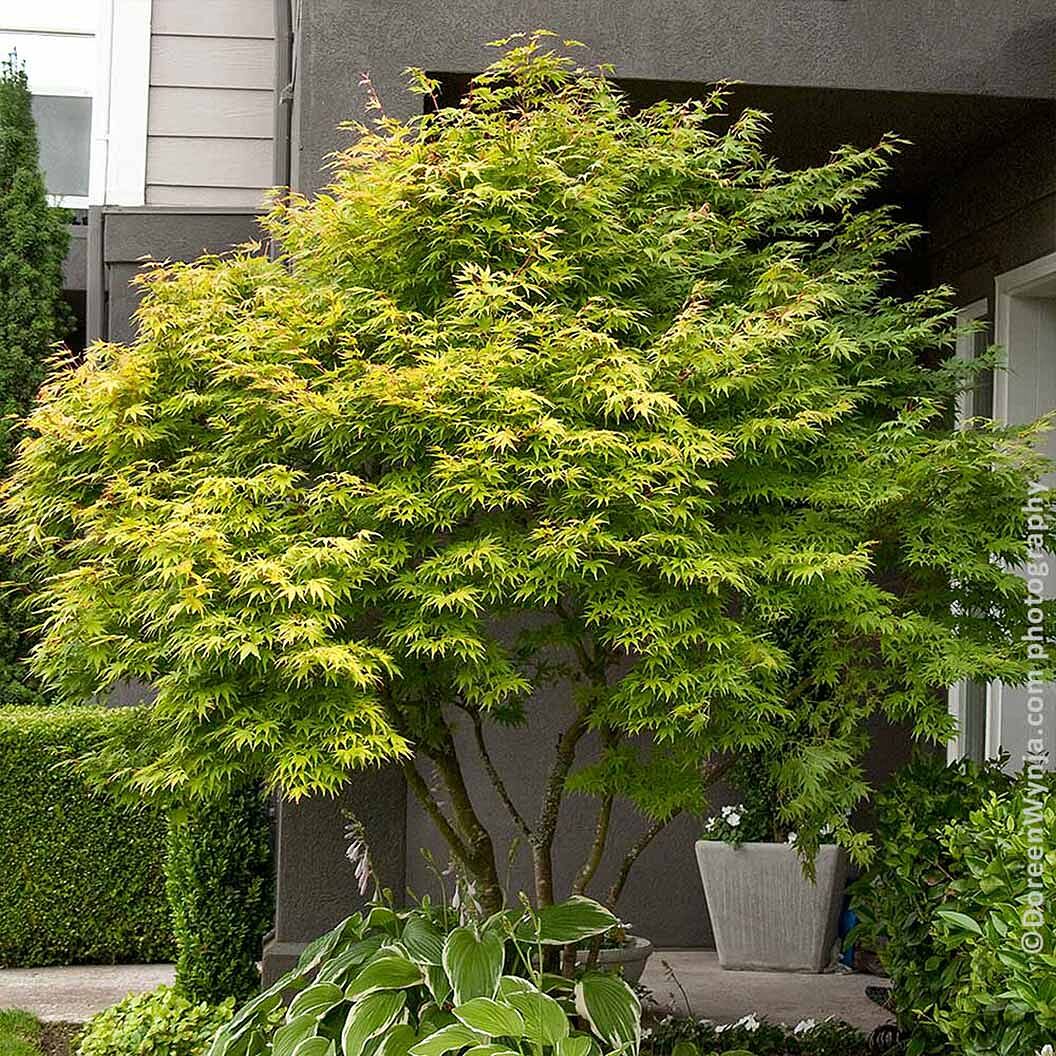
Japanese maple is more compact above and below ground. Its shape and growth habit varies by variety: some grow upright, some spread outward, and laceleaf types can form a low cascading shape. That range makes it workable as a feature tree in a foundation bed or beside a patio, where a red maple can damage a patio within its first ten years.
How Japanese maple and red maple are similar
They're both true maples, both deciduous trees, and both earn their keep in October. Both adapt to a decent range of soils, each with a preference of acidic soil. And both have been selected into dozens of named cultivars bred for leaf color, size, or form, which is why each name covers so much ground at the nursery.
Those similarities are why the two get confused. The decision comes down to scale and site, not to which is harder to grow.
How to choose between a Japanese maple or red maple
Still deciding? Start with the conditions in your yard and go from there.
- A small courtyard, patio bed, or large container: Japanese maple. At 6 to 25 feet it stays in bounds, and it's the space-saving shade tree we point people to most often for patios and urban yards.
- Want substantial shade for a large space? Choose a red maple. Larger Japanese maples, like Bloodgood, can provide plenty of shade for a patio or seating area, but they won't develop the broad canopy needed to shade a house like a red maple can.
- Planting within about 10 feet of a sidewalk, driveway, or foundation: Japanese maple. Red maple's surface roots are trouble that close to hardscape.
- Color from spring through fall: Japanese maple. The red-leafed cultivars hold their color all season.
- The fastest growth you can buy: red maple, specifically a Freeman hybrid.
- A tree you can tap for syrup: neither one, strictly speaking. That's sugar maple, Acer saccharum, shelved with the shade maples.

Top Japanese maples on the market
These are our four most-reviewed Japanese maples, in order. They're a good place to start if you're looking to buy your first one.
- Bloodgood Japanese Maple. Acer palmatum 'Bloodgood' is the default pick for the classic red look, and at 4.8 stars across 764 reviews it's the most-reviewed Japanese maple we sell. Reddish-purple foliage adds nice contrast against green shrubs and holds deep into summer before turning a gorgeous crimson.
- Mature size: 15 ft. tall, 15–25 ft. wide
- Zones: 5–8, hardy to -10℉
- Sunlight: full sun to partial shade
Tagged Cold Hardy and Deer Resistant, and it takes more sun than most Japanese maples.
- Coral Bark Japanese Maple. Acer palmatum 'Sango-kaku' earns 4.8 stars from 274 reviews, and its selling point, and most unusual feature, arrives after the leaves are gone: coral-red bark that glows against a gray February sky. Green summer foliage turns gold and orange.
- Mature size: 15–25 ft. tall, 10–12 ft. wide
- Zones: 5–8, hardy to -10℉
- Sunlight: partial shade
The tallest Japanese maple in our lineup, so give it headroom.
- Red Dragon Japanese Maple. Acer palmatum dissectum 'Red Dragon' is a weeping laceleaf rated 4.7 stars across 146 reviews. Finely dissected foliage emerges crimson, settles into burgundy for summer, and finishes fiery red.
- Mature size: 8–12 ft. tall, 8–12 ft. wide
- Zones: 5–8, hardy to -10℉
- Sunlight: partial shade
The cascading, mounding shape is the reason to buy it. Plant it where it can drape over a wall or a boulder.
- Tamukeyama Japanese Maple. Acer palmatum 'Tamukeyama' holds 4.8 stars from 126 reviews and grows wider than tall, with swooping branches and red foliage it keeps all season.
- Mature size: 6–8 ft. tall, 8–12 ft. wide
- Zones: 5–8, hardy to -10℉
- Sunlight: partial shade
Its page calls it out for containers and small landscapes.
One thing to know before you buy: every Japanese maple here is rated to zone 5 and hardy to -10℉. If you garden in zone 3 or 4, none of them is right for you, and we'd rather say so now. Autumn Blaze and Sugar Maple are hardy to -30℉ and give you the color without the winter heartbreak. None of these four ship to Alaska, Arizona, or Hawaii.
Top red maples available at Trees.com
Three of these are red maples in the horticultural sense. The fourth is here because you'll shop it alongside them.
- Autumn Blaze® Red Maple. Worth being precise about: Acer x freemanii 'Jeffersred' is a red maple crossed with silver maple, not a pure Acer rubrum. It's the fastest grower here at 3 to 5 feet a year and our most-reviewed maple at 4.7 stars from 933 reviews, with brilliant red-orange fall color and minimal mess once the leaves drop.
- Mature size: 40–50 ft. tall, 30–40 ft. wide
- Zones: 3–8, hardy to -30℉
- Sunlight: full sun
Tagged Drought Tolerant and Fast Growing. There's a tradeoff with that speed: NC State Extension notes wind and ice break branches on red maples, and fast growth tends to mean softer wood. Prune a young Autumn Blaze for structure early and you'll build a frame that holds up to storms later.
- Red Sunset® Maple. Acer rubrum 'Franksred' is a true red maple cultivar and our highest-rated maple at 4.9 stars from 295 reviews. Its claim to fame is that it's the standard for red maple cultivars. It's the benchmark cultivar that every other red maple cultivar is compared to.
- Mature size: 40–50 ft. tall, 30–35 ft. wide
- Zones: 4–9, hardy to -20℉
- Sunlight: full sun to partial shade
Tagged Cold Hardy and Fast Growing, with branching that stands up to wind.
- October Glory Red Maple. This Acer rubrum cultivar is rated 4.6 stars across 193 reviews and turns color later in fall, holding its vivid red foliage later into the season. That timing makes it especially well suited to the Southeast, where longer summers can cause earlier-coloring trees to look dull or drop their leaves before cooler fall weather arrives.
- Mature size: 40–50 ft. tall, 25–35 ft. wide
- Zones: 4–9, hardy to -20℉
- Sunlight: full sun to partial shade
Plant Red Sunset and October Glory together and you'll have red leaves somewhere on the property most of the autumn. October Glory is tagged Deer Resistant and rated a moderate grower.
- Sugar Maple. Acer saccharum is a separate maple species often shopped alongside red maples for its fall color, and it's one of our best sellers at 4.8 stars from 164 reviews. Its foliage shifts from gold to burnt orange to deep red, and it grows considerably larger than the other maples here. Sugar maples are best suited to the Northeast, as Southern climates are generally too hot and Western soils can leave them prone to chlorosis.
- Mature size: 55–75 ft. tall, 30–50 ft. wide
- Zones: 3–8, hardy to -30℉
- Sunlight: full sun to partial shade
This is the classic syrup tree, and is Vermont’s official state tree. A mature one can be tapped, though "mature" is the operative word.
These four don't ship to Alaska, Arizona, or Hawaii either.
How to plant and grow Japanese maple and red maple Trees
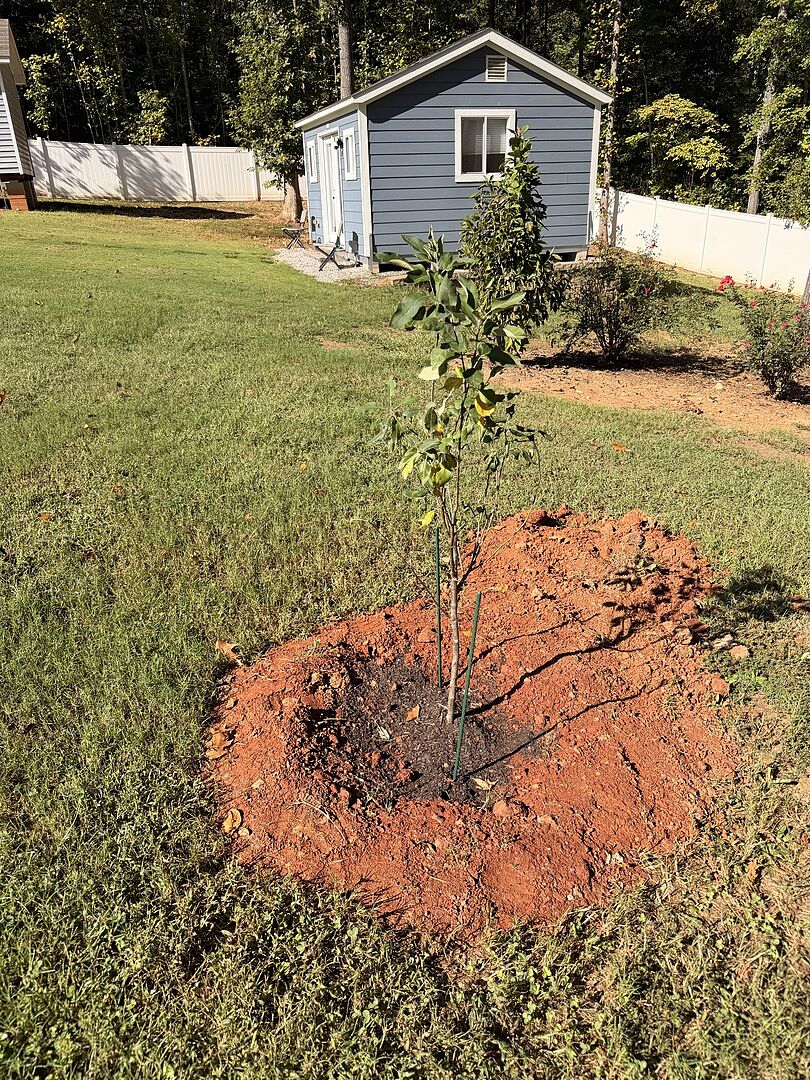
The basics are the same for both. Plant in fall or early spring while temperatures are mild. Dig the hole two to three times as wide as the root ball but no deeper than the ball itself, so its top sits level with the grade. Water deeply through the first two growing seasons, then mulch a few inches deep and keep it off the trunk.
Where the two diverge is sun and soil.
Sunlight and planting location
Red maple takes full sun to partial shade and needs plenty of open space for the canopy and the roots under it. Plant it 20 feet or more from the house, and even further from any pavement you care about.
Japanese maple prefers dappled or partial shade. Excess sun, wind, or drought can cause leaf scorch. Afternoon shade is the best thing you can do for one in a hot climate, and morning sun against an east-facing wall is close to ideal. Because the root system is small, siting it near a patio is fine, unlike a red maple.
Soil and Watering
Japanese maple prefers evenly moist, well-drained soil that is slightly acidic and rich in organic matter. It doesn’t respond well to drying out. Consistent water while young is what prevents crispy leaf edges later.
Red maple is the more adaptable. NC State Extension lists it as tolerant of clay, loam, sand, and occasional wet soil. Red maple still needs acidic soil, but is tolerant of both short periods of drought or flooding. Young trees still need regular water for the first couple of years.

Common problems and how to avoid them
- Leaf scorch on Japanese maple: Brown, crispy leaf margins in July usually mean too much sun, too much wind, or not enough water, and NC State Extension lists all three as triggers. It's rarely fatal and it's preventable: site for afternoon shade and water deeply in dry spells.
- Girdling roots on either tree: Girdling roots are roots that grow around or against the tree's trunk instead of spreading outward. Over time, they can restrict the trunk and interfere with the tree's ability to take up water and nutrients. University of Maryland Extension names red and sugar maples among the species most likely to develop girdling roots, and points to poor planting technique, deep mulch, and compacted soil as the causes. Loosen and straighten circling roots before backfilling, plant at the correct depth, and keep mulch shallow.
- Surface roots and hardscape: NC State Extension is direct about this one: red maple's shallow root system may buckle nearby sidewalks or driveways if the tree is planted too close. There's no fixing it later, since cutting surface roots on an established tree does more harm than good.
- Alkaline soil: red maples get iron and manganese chlorosis in high-pH ground, which shows up as yellow leaves with green veins, and NC State Extension flags it on the species. Test your soil first. If the pH comes back high or you live in the Western United States, choose a tree that is better adapted for your region, as adjusting the pH can be time consuming and costly. Chlorosis can reduce the beauty and health of red and Japanese maples.
Japanese maple or red maple: which one fits your yard?
Picking a Japanese maple or red maple comes down to the space you have and the role you want the tree to play. Japanese maple gives you compact, ornamental, season-long color in a space measured in feet. Red maple gives you fast, large-scale shade in a space measured in decades of canopy. Either way, buy for the spot you actually have.
Compare mature sizes and hardiness zones across the Japanese maple trees and maple trees collections before you order, since the zone rating is the one spec you can't work around.
Shop with confidence
Whichever maple you choose, it's covered by our 1-year Alive & Thrive Guarantee™, so it arrives alive and healthy. If it dies of natural causes within its first year, we'll provide a one-time replacement.
Still torn? Book a Plant Expert consultation and we'll help you match the tree to your yard and your zone.
Frequently Asked Questions
Is a Japanese maple a type of red maple?
No. Japanese maple is Acer palmatum, native to Japan and Korea. Red maple is Acer rubrum, native to eastern North America. Separate species in the same genus, sharing little beyond red fall foliage.
Why do some Japanese maples look red all summer, not just in fall?
Cultivar selection. Varieties like Bloodgood and Red Dragon hold red or purple pigment through the growing season rather than only in autumn. That season-long color is why they picked up the nickname "Japanese red maple."
Which grows faster, Japanese maple or red maple?
Red maple, by a wide margin. NC State Extension rates its growth as rapid, and Autumn Blaze puts on 3 to 5 feet a year. Japanese maple is slow to moderate. If speed is your priority, this isn't close.
Can Japanese maple roots damage sidewalks or foundations?
Rarely. Japanese maple stays small and its roots stay proportional to the canopy, so it's generally safe near patios and foundation beds. Red maple is the opposite case, with shallow surface roots that can buckle nearby pavement.
Which is better for a small yard, Japanese maple or red maple?
Japanese maple. Mature heights run 6 to 25 feet by variety, and weeping forms like Tamukeyama stay under 8 feet. A red maple needs 30 or more feet of open room and will outgrow a small lot within two decades.
Is sugar maple the same as red maple?
No. Sugar maple is Acer saccharum, a different species that grows larger and slower than red maple cultivars, and it's the tree tapped for syrup. People shop the two together for fall color, but they aren't interchangeable. Sugar maple grows best in the Northeast, where the summers are cooler. They aren't well suited to long, hot summers.